Hotline: +84 928 718 688
No. 49, Lane 147 Vu Xuan Thieu Street, Group 12, Phuc Loi Ward, Ha Noi, Vietnam
Vietnam has become an established sourcing destination for international apparel buyers seeking reliable manufacturing capacity, skilled garment production, and flexible customization. Beyond conventional fashion products, Vietnamese manufacturers can also support specialized categories such as carnival costumes, festival clothing, event apparel, promotional garments, and seasonal costumes.
However, sourcing carnival and event apparel presents different challenges from purchasing standard garments. These products often feature complex designs, multiple fabrics, decorative accessories, custom printing, unusual construction, and strict seasonal delivery schedules.
For international brands, wholesalers, importers, retailers, event organizers, and costume distributors, ing the right carnival and event apparel manufacturer in Vietnam requires careful evaluation of production capabilities, material sourcing, quality control, customization, lead times, and export experience.
This guide explains the key factors buyers should consider before placing carnival or event apparel orders in Vietnam.
Carnival and event apparel is often more complicated to manufacture than basic garments.
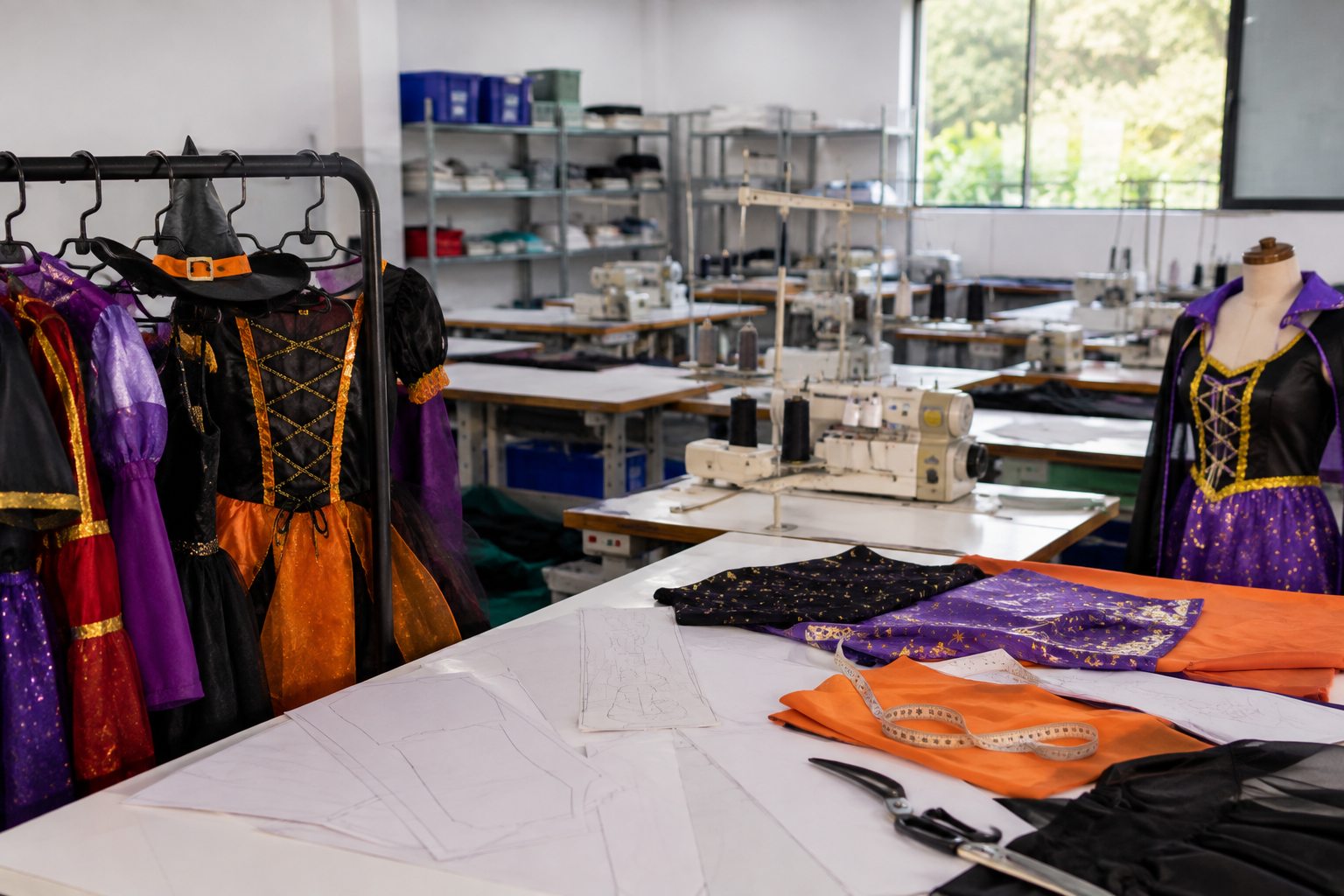
A standard T-shirt may require only one primary fabric and relatively simple sewing operations. A carnival costume, by comparison, may combine several materials and decorative components within one design.
Common materials and components include:
Polyester fabrics
Satin
Velvet
Mesh
Tulle
Sequins
Lace
Faux fur
Elastic materials
Metallic fabrics
Printed panels
Embroidery
Decorative trims
Buttons and zippers
Costume accessories
The more components a garment contains, the more carefully material sourcing, production sequencing, and quality control must be managed.
International buyers should therefore choose manufacturers with experience handling complex costume and event apparel construction, rather than evaluating suppliers based only on general garment manufacturing capacity.
Not every apparel factory is suitable for carnival or event clothing.
Before placing an order, buyers should determine whether the manufacturer has previously produced similar garment categories.
Relevant experience may include:
Carnival costumes
Festival costumes
Halloween costumes
Christmas apparel
Party clothing
Stage costumes
Promotional apparel
Event uniforms
Themed garments
Children's costumes
Custom event clothing
Ask potential suppliers to provide examples of comparable products where possible.
Previous experience with complex apparel can indicate whether the manufacturer understands specialized sewing techniques, decorative details, material combinations, and seasonal production requirements.
Customization is one of the most important requirements in event apparel manufacturing.
International buyers often develop collections specifically for a brand, retailer, festival, event, promotional campaign, or target market.
A suitable manufacturer should be able to work from information such as:
Tech packs
Technical drawings
Reference samples
Size charts
Artwork
Color references
Material specifications
Construction requirements
Packaging instructions
Customization may cover the entire garment or individual elements such as prints, embroidery, labels, trims, and packaging.
Before confirming production, buyers should establish exactly which customization processes can be completed by the manufacturer and which processes are outsourced.
Material sourcing has a major impact on the quality, price, and lead time of carnival apparel.
Because costumes may contain several different materials, buyers should evaluate the manufacturer's ability to coordinate multiple suppliers.
Important sourcing considerations include:
Confirm whether required fabrics are readily available or need to be custom-developed or imported.
Fabric mills and accessory suppliers may have their own MOQ requirements, even when the garment factory accepts smaller production quantities.
Custom colors may require lab dips, strike-offs, or other approval processes before bulk material production.
Sequins, lace, trims, feathers, metallic materials, specialty buttons, and other accessories can require additional sourcing time.
Materials used in bulk production should match approved samples in appearance, performance, and relevant specifications.
Early material confirmation is particularly important for time-sensitive seasonal programs.
Sampling is essential when sourcing custom carnival and event apparel.
Because these garments can involve unusual silhouettes and decorative elements, buyers should not proceed directly from a design concept to bulk manufacturing.
Depending on the project, the sampling process may include:
Development sample &rarr Fit sample &rarr Revised sample &rarr Size-set sample &rarr Pre-production sample
During sample evaluation, buyers should review:
Overall appearance
Garment construction
Measurements
Fit
Fabric
Colors
Stitching
Print quality
Embroidery
Decorative components
Accessory placement
Labels
Packaging
An approved pre-production sample can then serve as an important reference during bulk manufacturing.
Minimum order quantity is another key factor when sourcing event apparel.
MOQ requirements may vary according to:
Garment design
Fabric type
Number of colors
Number of sizes
Printing method
Embroidery requirements
Custom accessories
Packaging
Total order volume
Buyers managing multiple costume designs should discuss whether MOQ applies per style, per color, or across the entire order.
For example, a factory may accept a certain garment quantity, but a custom printed fabric or decorative accessory may require a higher minimum production volume.
Clarifying these requirements before sampling can prevent unexpected cost increases later.
Seasonal and event apparel often needs to be produced within a fixed period.
Buyers should therefore verify whether the factory has sufficient production capacity during the required manufacturing window.
Important questions include:
What is the factory's monthly capacity?
How many production lines are available?
How many styles can be produced simultaneously?
Can the factory manage complex garments?
How does the supplier handle peak-season capacity?
Which processes are subcontracted?
How are subcontractors monitored?
A manufacturer may have substantial overall capacity but still be unsuitable if its production lines are already committed during the buyer's required period.
Capacity should therefore be confirmed specifically for the planned production schedule.
For carnival and event apparel, delivery timing can be just as important as product quality.
These garments usually have fixed commercial deadlines. Carnival clothing must arrive before carnival season, while event merchandise must be available before the scheduled event.
A realistic production timeline should include:
Product development &rarr Material sourcing &rarr Sampling &rarr Approval &rarr Bulk material preparation &rarr Cutting &rarr Sewing &rarr Decoration &rarr Finishing &rarr Inspection &rarr Packing &rarr Export
International buyers should avoid calculating lead time based only on sewing.
Fabric delays, sample revisions, custom printing, accessory development, quality corrections, and logistics can all extend the schedule.
For seasonal orders, placing orders early provides additional time to manage unexpected issues without affecting the final delivery date.
Costumes may be temporary or seasonal products, but this does not mean quality control should be overlooked.
Quality expectations should be defined according to the product, price segment, target market, and buyer requirements.
Typical inspection points include:
Fabric defects
Color consistency
Garment measurements
Cutting accuracy
Stitching
Seam construction
Print positioning
Embroidery quality
Decorative trim attachment
Zippers and closures
Label placement
Finished appearance
Packing quantity
For costumes containing detachable accessories, buyers should also establish clear requirements for accessory inclusion and packaging.
Quality control during production can help identify problems before they affect the entire order.
Product requirements may differ depending on the destination market and intended users.
This is particularly important for children's costumes and accessories.
Depending on the product and destination, buyers may need to consider requirements relating to:
Material composition
Restricted substances
Flammability
Small components
Drawstrings and cords
Product labeling
Fiber content
Care instructions
Country-of-origin marking
International buyers should determine applicable requirements for their own markets and communicate them clearly to the manufacturer before material sourcing and production.
Testing requirements should also be agreed before bulk manufacturing where necessary.
Visual impact is particularly important for carnival and event clothing.
Many products rely heavily on decorative techniques to create their final appearance.
Common processes include:
Screen printing
Sublimation printing
Heat transfer
Embroidery
Sequins
Appliqué
Decorative stitching
Specialty trims
Buyers should request samples of relevant techniques before bulk production.
For printed products, artwork size, placement, colors, and production method should be confirmed.
For embroidery, stitch density, thread colors, positioning, and backing should be reviewed.
Decorative elements should also be checked for consistency and secure attachment.
Carnival apparel may be sold across several age groups and markets.
Depending on the program, a collection might include:
Children's sizes
Teen sizes
Adult sizes
Unisex sizing
Plus sizes
Buyers should provide clear measurement charts and tolerances.
For multi-size orders, size-set samples can help verify grading before bulk cutting begins.
This is particularly useful for complicated costumes where proportions, decorative elements, or accessories need to remain visually consistent across sizes.
Packaging is an important part of event and costume sourcing.
Retail products may require:
Individual polybags
Printed s
Hangtags
Barcode labels
Size stickers
Product identification
Retail-ready packaging
Customized cartons
Carton markings
If a costume includes several separate pieces, packaging instructions should clearly specify which components belong to each set.
This helps prevent missing accessories or incorrect combinations during packing.
Vietnamese garment suppliers may operate under different production arrangements.
Under Cut, Make and Trim, buyers generally maintain greater responsibility for materials, while the factory focuses primarily on garment production.
Under an OEM model, the manufacturer produces garments according to the buyer's designs and technical specifications.
For FOB garment sourcing, the supplier may coordinate materials, production, packing, export preparation, and delivery according to the agreed FOB terms.
International buyers should clarify the exact manufacturing scope instead of assuming all factories include the same services.
For customized seasonal programs, an integrated OEM and FOB arrangement can simplify supplier management when the manufacturer has suitable sourcing and export capabilities.
Cost is important, but the cheapest quotation does not necessarily provide the best sourcing result.
Buyers should compare suppliers based on factors such as:
Material quality
Manufacturing capability
Sampling
MOQ
Production capacity
Workmanship
Quality control
Lead time
Packaging
Communication
Export experience
For time-sensitive event apparel, a slightly lower unit price may offer little benefit if the supplier cannot meet the required delivery schedule.
Custom apparel production requires frequent coordination between buyer and supplier.
A reliable manufacturer should communicate clearly about:
Material availability
Sampling progress
Technical questions
Product changes
Production status
Quality issues
Inspection schedules
Shipment preparation
Buyers should evaluate communication quality during the quotation and sampling stages.
If technical questions remain unanswered or timelines frequently change before an order is placed, similar issues may continue during bulk production.
For international buyers, export experience is another important supplier-ion criterion.
A manufacturer familiar with overseas orders should understand requirements involving:
Commercial documentation
Packing lists
Carton markings
Shipping coordination
Export preparation
Freight forwarder communication
Buyer-specific documentation
Buyers should also confirm the agreed Incoterm, shipping point, and responsibilities of each party before finalizing the purchase order.
Before ing a Vietnamese supplier, international buyers should ask:
What types of carnival and event apparel have you manufactured?
Can you produce according to our tech packs or reference samples?
Can you source specialized fabrics and decorative accessories?
What is your MOQ by style and color?
What is your sampling lead time?
What is your bulk production capacity?
Which production processes are handled in-house?
Which processes are subcontracted?
How do you control quality during production?
Can you support custom printing and embroidery?
Can you produce private labels and customized packaging?
Can you handle multi-piece costume sets?
Do you support OEM and FOB orders?
What is your estimated production lead time?
What export markets have you previously served?
The answers provide a clearer picture of whether a manufacturer is suitable for the buyer's specific program.
Successful carnival and event apparel sourcing from Vietnam requires careful coordination across product development, material sourcing, sampling, manufacturing, quality control, packaging, and export preparation.
International buyers should suppliers based on their actual capabilities rather than price alone. Experience with complex costumes, access to suitable fabrics and accessories, flexible customization, reliable production capacity, quality management, and lead-time control are particularly important for seasonal products.
For brands, wholesalers, retailers, importers, event companies, and costume distributors, working with an experienced carnival and event apparel manufacturer in Vietnam can provide a more efficient way to develop customized collections for international markets.
By providing clear technical specifications, confirming materials early, approving samples before production, and establishing realistic delivery schedules, buyers can reduce sourcing risks and build more reliable long-term apparel manufacturing programs in Vietnam.
CATEGORIES
Women’s fine horizontal-striped festival apparel
Women’s fine horizontal-striped festival apparel
Festival long-sleeve crew-neck apparel
Festival long-sleeve turtleneck apparel
Striped festival crossbody bag
Short-sleeve sailor-style festival top
Women’s fine horizontal-striped festival apparel
Women’s fine horizontal-striped festival apparel
FOB Garment Manufacturing in Vietnam: A Complete Guide for International Buyers
How Topaz Clothing Supports Seasonal Apparel Programs with Reliable Lead Times
How to Choose a Reliable Seasonal Costume Manufacturer in Vietnam
FOB vs. OEM Garment Manufacturing: What International Buyers Should Know
Key Factors When Sourcing Carnival and Event Apparel from Vietnam
Featured Products & Services
*YOU MAY ALSO LIKE
We look forward to establishing a successful and long-term cooperation with your company.
Address: No. 49, Lane 147 Vu Xuan Thieu Street, Group 12, Phuc Loi Ward, Ha Noi, Vietnam
Hotline: +84 928718688
Topaz Clothing JSC is a Vietnam-based garment manufacturer specializing in FOB production for seasonal wear, carnival costumes, and event apparel, established in 2014.
Topaz Orion Import Export Company Limited
Address: No. 49, Lane 147 Vu Xuan Thieu Street, Group 12, Phuc Loi Ward, Ha Noi, Vietnam
Hotline: +84 928718688
Topaz Orion Import Export Company Limited
Địa chỉ: No. 49, Lane 147 Vu Xuan Thieu Street, Group 12, Phuc Loi Ward, Ha Noi, Vietnam
Business Registration Certificate No. 0111425424 – Issued by the Department of Planning and Investment of Ha Noi on March 23, 2026
Responsible for content - Ms Loan
@ Copyright by Topaz Orion Import Export Company Limited. Designed by Vietnam Yellow Pages.