Hotline: +84 928 718 688
No. 49, Lane 147 Vu Xuan Thieu Street, Group 12, Phuc Loi Ward, Ha Noi, Vietnam
For international apparel buyers, choosing the right manufacturing model is an important part of building an efficient sourcing strategy. Two terms frequently encountered when sourcing clothing from Vietnam and other major garment-producing markets are FOB garment manufacturing and OEM garment manufacturing.
Although FOB and OEM are sometimes used interchangeably in apparel sourcing discussions, they describe different aspects of a transaction. OEM relates primarily to how a product is manufactured according to the buyer's specifications, while FOB defines a delivery term that determines responsibilities, costs, and risk during shipment.
Understanding the difference between FOB vs. OEM garment manufacturing can help brands, wholesalers, retailers, importers, and sourcing companies communicate more clearly with suppliers, compare quotations accurately, and a manufacturing arrangement that fits their business.
OEM stands for Original Equipment Manufacturer. In the apparel industry, OEM manufacturing generally refers to a factory producing garments according to specifications, designs, samples, or technical requirements provided by the buyer.
The buyer typically controls the product concept and branding, while the manufacturer converts those requirements into finished garments.
An OEM garment project may involve:
Tech pack review
Pattern development
Sample making
Fabric and trim ion
Cutting
Sewing
Printing
Embroidery
Finishing
Quality inspection
Private labeling
Customized packaging
The exact scope varies between manufacturers and contracts.
For example, an international fashion brand may provide a complete tech pack containing measurements, fabric specifications, artwork, construction details, colors, labels, and packaging requirements. The OEM factory then manufactures the garments according to those instructions.
FOB stands for Free On Board.
Unlike OEM, FOB is not fundamentally a product-development model. It is an international trade term defining how goods are delivered and when certain costs and risks transfer between seller and buyer.
In an FOB garment order, the supplier typically manages production and delivers the finished goods on board the vessel at the agreed port of shipment.
An FOB arrangement in apparel sourcing may therefore include:
Material sourcing => Sampling => Production => Quality control => Packing => Export preparation => Delivery to the agreed port => Loading on board
The precise responsibilities should always be confirmed in the purchase contract.
An FOB quotation should also specify the named port, for example:
FOB Hai Phong
or
FOB Ho Chi Minh City
This is important because FOB without a named port does not provide sufficient commercial detail.
The key point for international buyers is that FOB and OEM are not direct opposites.
OEM answers the question:
"Who develops and manufactures the garment according to the buyer's design?"
FOB answers another question:
"How and where is the finished shipment delivered to the buyer?"
This means an apparel order can actually be both OEM and FOB.
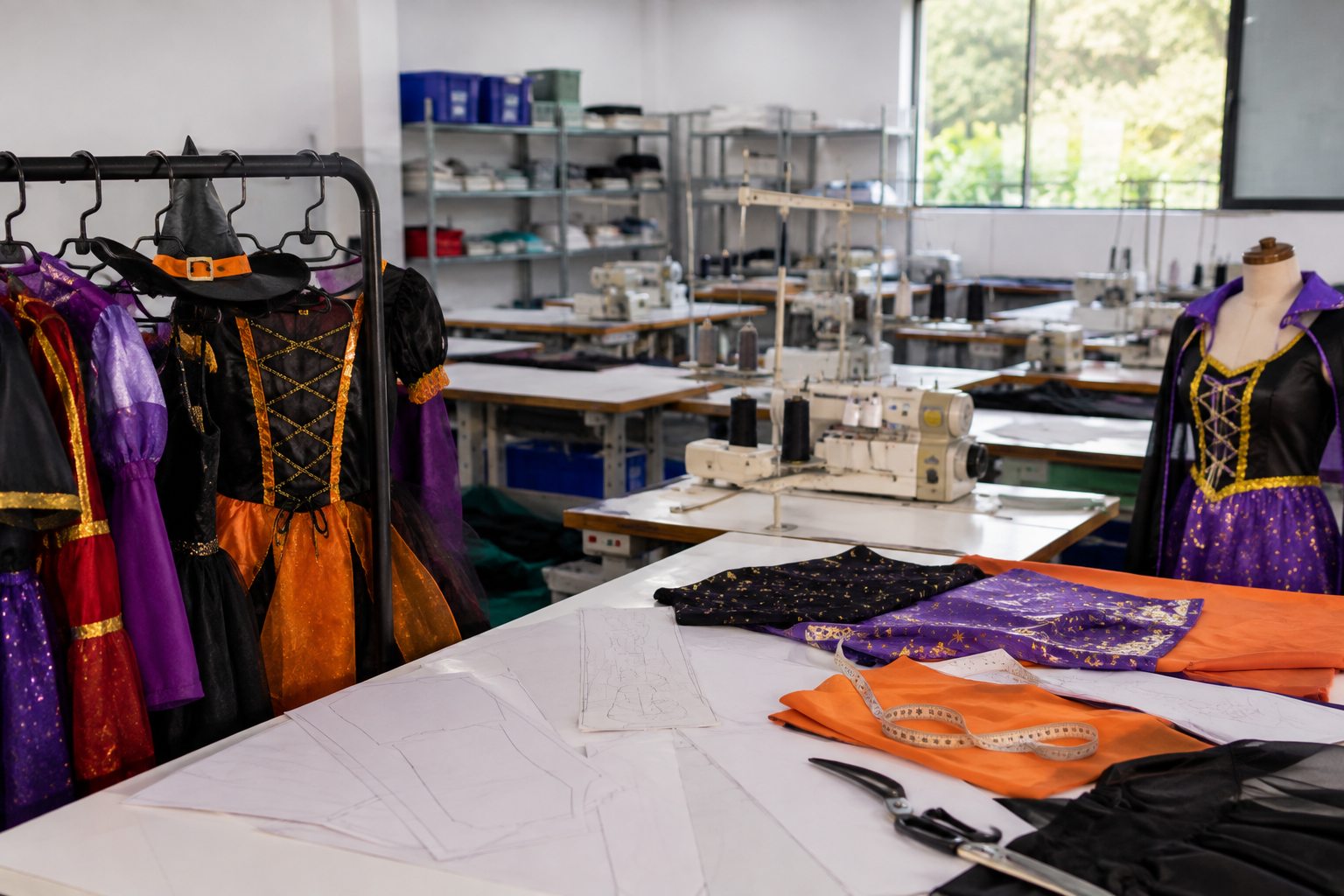
For example, a Vietnamese manufacturer may produce custom Halloween costumes according to an overseas buyer's technical specifications under an OEM arrangement and sell those products under FOB shipping terms.
Understanding this distinction helps buyers avoid confusion when requesting quotations.
| Factor | OEM Garment Manufacturing | FOB Garment Manufacturing |
|---|---|---|
| Main purpose | Custom manufacturing | Delivery and trade arrangement |
| Buyer provides design | Usually | Can be included |
| Custom product development | Common | Depends on manufacturing agreement |
| Sampling | Usually available | Often included in garment sourcing |
| Material sourcing | Depends on agreement | Often supplier-managed |
| Bulk production | Manufacturer | Manufacturer |
| Private labeling | Common | Can be included |
| Packaging | Customizable | Usually prepared before export |
| Export responsibility | Depends on contract | Seller handles agreed FOB obligations |
| Main focus | Product manufacturing | Delivery point, costs and risk |
The table illustrates why buyers should clarify both the manufacturing scope and Incoterm separately.
A typical OEM apparel project begins with the buyer's product concept.
The buyer sends information such as:
Technical drawings
Tech packs
Size charts
Fabric requirements
Color references
Artwork
Construction details
Labels
Packaging specifications
Detailed documentation helps reduce misunderstandings during development.
The manufacturer identifies suitable fabrics, trims, and accessories according to the buyer's requirements.
Depending on the agreement, the buyer may nominate specific material suppliers or allow the manufacturer to source alternatives.
The factory develops samples for evaluation.
Depending on the product, this may include:
Development samples
Fit samples
Size-set samples
Color samples
Pre-production samples
Revisions continue until the necessary specifications are approved.
After approval, the factory begins production.
Common stages include:
Fabric inspection => Cutting => Printing/Embroidery => Sewing => Finishing => Inspection => Packing
Finished garments are inspected according to agreed quality requirements before packing and shipment.
The delivery responsibilities then depend on the agreed Incoterm, such as FOB.
FOB sourcing often involves broader supply-chain coordination by the supplier.
After receiving the buyer's requirements, the garment manufacturer may coordinate:
Fabric purchasing
Trim sourcing
Sample development
Material approvals
Bulk manufacturing
Quality inspection
Labeling
Packing
Export documentation
Inland transportation to the port
Agreed loading procedures
After the goods are loaded on board at the named port, responsibility transfers according to the applicable FOB terms and sales agreement.
The buyer normally arranges the main international freight and subsequent transportation.
Yes.
This is common in international garment sourcing.
A manufacturer can provide OEM garment manufacturing services while selling the finished products under FOB terms.
Consider an international retailer ordering a custom seasonal costume collection from Vietnam.
The retailer provides:
Costume concepts
Technical specifications
Size charts
Artwork
Branding requirements
The Vietnamese manufacturer develops samples, sources materials, manufactures the costumes, applies labels, and packs the products.
This is an OEM manufacturing relationship.
If the manufacturer then delivers and loads the products on board at an agreed Vietnamese port under FOB terms, the commercial shipment is also FOB.
Therefore, buyers should not necessarily ask:
"Do you offer FOB or OEM?"
A more accurate question is:
"Can you provide OEM manufacturing, and can the order be quoted under FOB terms?"
OEM allows buyers to develop garments according to their own specifications rather than purchasing only standard products.
Brands can manufacture apparel under their own labels, packaging, and commercial identity.
Buyers can define important details such as fabric, measurements, colors, construction, prints, and accessories.
OEM manufacturing is particularly useful for products requiring customized development, including:
Fashion collections
Uniforms
Sportswear
Workwear
Children's apparel
Promotional clothing
Halloween costumes
Carnival costumes
Christmas apparel
Festival and event clothing
The supplier can coordinate multiple manufacturing and sourcing activities before export.
International buyers may not need to manage individual fabric mills, accessory suppliers, production factories, and local logistics providers separately.
FOB establishes a defined point at which the seller completes its agreed delivery responsibility.
The buyer can arrange international ocean transportation through its preferred freight forwarder or logistics provider.
For companies importing garments in significant quantities, FOB can provide a practical structure for coordinating production in Vietnam with international logistics.
There is no universal answer because OEM and FOB solve different sourcing requirements.
Buyers that require customized garments should consider an OEM-capable manufacturer.
Buyers that want the supplier to deliver finished goods under an established international shipping term may request FOB pricing.
In many cases, international apparel buyers need both.
For example:
OEM manufacturing + FOB shipping terms
can provide a practical arrangement for a brand that wants customized products while maintaining control over international freight.
International buyers sourcing garments from Vietnam may also encounter CMT manufacturing.
CMT stands for Cut, Make and Trim.
Under a traditional CMT arrangement, the buyer generally maintains greater responsibility for supplying or arranging materials, while the manufacturer primarily performs garment production.
A simplified comparison looks like this:
| Model | Primary Function |
|---|---|
| CMT | Factory mainly performs cutting and garment assembly |
| OEM | Factory manufactures according to buyer specifications |
| FOB | Defines agreed delivery responsibilities and shipment point |
In practice, the exact services offered under each commercial arrangement can vary significantly between factories.
Buyers should therefore focus on the actual scope stated in the quotation and contract rather than relying solely on terminology.
When receiving an FOB quotation, buyers should verify exactly what the price includes.
Important components may include:
Main fabric
Lining
Trims
Accessories
Labels
Printing
Embroidery
Cutting and sewing
Finishing
Quality control
Packaging
Inland transportation
Export-related costs covered by the seller
Named port of shipment
Buyers should also clarify what is not included.
For example, main international freight, destination charges, import customs clearance, duties, and inland delivery in the destination country are generally outside the seller's FOB scope.
International buyers should evaluate more than price.
Does the manufacturer have experience producing the required garment category?
Can the factory accurately convert technical specifications into production-ready samples?
Can suitable fabrics, trims, and accessories be sourced within the required budget and timeline?
Can the manufacturer handle the required order volume without compromising delivery schedules?
Are inspections conducted throughout production?
Can the manufacturer support custom colors, printing, embroidery, labels, and packaging?
Does the supplier respond clearly to technical questions and document product changes?
Does the company have experience handling international garment orders and export documentation?
International buyers should ask potential garment manufacturers:
Do you provide OEM manufacturing?
Can you source fabrics and accessories?
Which processes are completed in-house?
What is your MOQ by style and color?
How long does sampling take?
What is your typical production lead time?
Can you produce according to our tech pack?
What quality control procedures do you use?
Can you provide private labels and customized packaging?
Can you quote FOB?
Which FOB port do you normally use?
What costs are included in your FOB quotation?
What processes are subcontracted?
What export markets do you currently serve?
Clear answers help buyers evaluate suppliers on comparable terms.
Vietnam has developed a strong position within the international textile and apparel supply chain.
For overseas buyers, the country offers access to manufacturers producing a wide range of garment categories, from basic apparel to customized fashion, uniforms, workwear, sportswear, promotional clothing, and seasonal costumes.
Vietnam can be particularly relevant for buyers seeking:
OEM garment manufacturing
FOB garment sourcing
Private-label apparel production
Custom garment development
Seasonal costume manufacturing
Export-oriented production
Long-term manufacturing partnerships
However, factory capabilities vary considerably. Buyers should verify each manufacturer's specialization, capacity, sourcing network, quality system, and export experience before placing orders.
A successful sourcing program requires clear responsibilities between buyer and supplier.
International buyers should:
Prepare complete tech packs
Confirm fabric specifications
Define acceptable measurement tolerances
Approve samples before bulk production
Confirm material availability
Establish realistic production schedules
Document all product changes
Define quality inspection requirements
Confirm packaging specifications
Review the Incoterm and named port
Confirm payment terms
Review shipping documents before dispatch
For first-time cooperation, buyers may also consider beginning with a trial order before increasing production volumes.
Understanding FOB vs. OEM garment manufacturing is essential for international buyers sourcing apparel from Vietnam.
OEM primarily describes a manufacturing relationship in which a factory produces garments according to the buyer's specifications, designs, and branding requirements. FOB, meanwhile, is an international trade term defining the seller's and buyer's responsibilities around delivery of the goods at the agreed port of shipment.
They are therefore not mutually exclusive.
An international brand can work with a Vietnamese supplier for OEM garment manufacturing while purchasing the finished products under FOB terms.
For buyers, the most important step is to clearly define both sides of the arrangement: what the manufacturer is responsible for producing and what each party is responsible for during delivery and shipping.
By confirming product specifications, sourcing responsibilities, pricing scope, quality requirements, lead times, and shipping terms before production begins, international buyers can reduce sourcing risks and build a more efficient garment manufacturing program in Vietnam.
CATEGORIES
Women’s fine horizontal-striped festival apparel
Women’s fine horizontal-striped festival apparel
Festival long-sleeve crew-neck apparel
Festival long-sleeve turtleneck apparel
Striped festival crossbody bag
Short-sleeve sailor-style festival top
Women’s fine horizontal-striped festival apparel
Women’s fine horizontal-striped festival apparel
FOB Garment Manufacturing in Vietnam: A Complete Guide for International Buyers
How Topaz Clothing Supports Seasonal Apparel Programs with Reliable Lead Times
How to Choose a Reliable Seasonal Costume Manufacturer in Vietnam
FOB vs. OEM Garment Manufacturing: What International Buyers Should Know
Key Factors When Sourcing Carnival and Event Apparel from Vietnam
Featured Products & Services
*YOU MAY ALSO LIKE
We look forward to establishing a successful and long-term cooperation with your company.
Address: No. 49, Lane 147 Vu Xuan Thieu Street, Group 12, Phuc Loi Ward, Ha Noi, Vietnam
Hotline: +84 928718688
Topaz Clothing JSC is a Vietnam-based garment manufacturer specializing in FOB production for seasonal wear, carnival costumes, and event apparel, established in 2014.
Topaz Orion Import Export Company Limited
Address: No. 49, Lane 147 Vu Xuan Thieu Street, Group 12, Phuc Loi Ward, Ha Noi, Vietnam
Hotline: +84 928718688
Topaz Orion Import Export Company Limited
Địa chỉ: No. 49, Lane 147 Vu Xuan Thieu Street, Group 12, Phuc Loi Ward, Ha Noi, Vietnam
Business Registration Certificate No. 0111425424 – Issued by the Department of Planning and Investment of Ha Noi on March 23, 2026
Responsible for content - Ms Loan
@ Copyright by Topaz Orion Import Export Company Limited. Designed by Vietnam Yellow Pages.